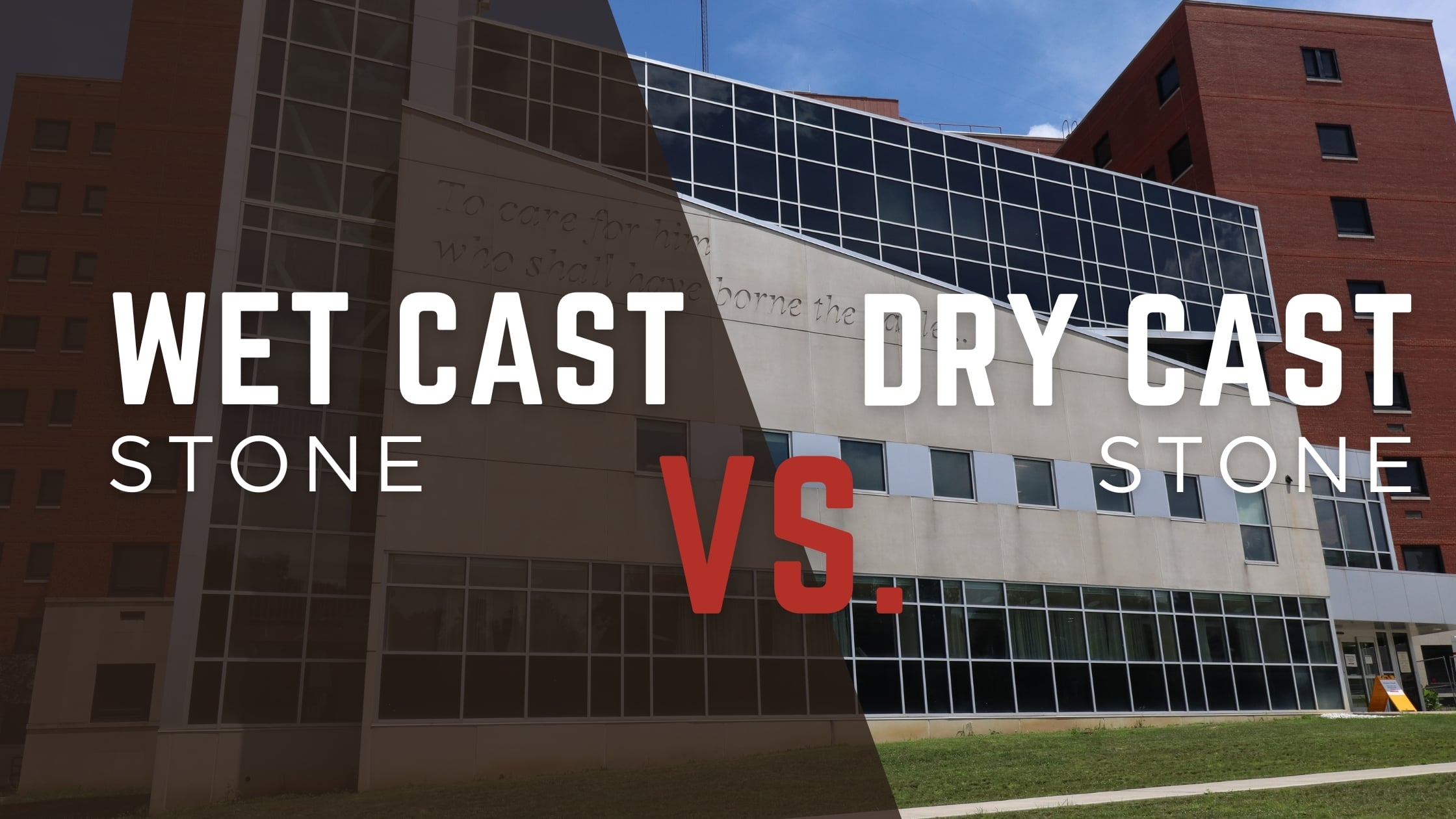
When it comes to cast stone, one question comes up again and again: Should I choose wet cast or dry cast? The answer isn’t always simple—but understanding the differences can make all the difference in your next project.
A Legacy of Innovation at Reading Rock
Since 1947, Reading Rock has grown from a concrete block manufacturer into a leader in architectural cast stone and precast solutions. Today, we produce both dry tamp (RockCast Dry) and wet cast (RockCast Wet) stone. Both are manufactured to the same rigorous ASTM C1364 standard.
Why both? Because different projects demand different solutions—whether it's performance, aesthetics, cost, or installation speed.
Dry Cast Stone: Natural Beauty, Built for Efficiency
Dry cast stone is all about replicating the look and feel of natural limestone—with speed and consistency.
Why Choose Dry Cast
- Authentic Look: Closely mimics natural cut stone with fine textures
- Fast Production: Molds can produce 30–40 pieces per day
- Consistent Color: Less prone to efflorescence
- Quick Turnaround: Immediate removal from molds speeds delivery
- Ideal for Masonry: Perfect for hand-set applications and detailed architectural elements
Best Applications
- Veneers and trim
- Architectural accents
- Repetitive, smaller-scale components
Keep in Mind
- Not typically structural
- Size limitations (generally smaller pieces)
- Edges can be more susceptible to wear in high-traffic areas
Wet Cast Stone: Strength Meets Versatility
When projects demand larger, structural components, wet cast stone steps in.
Why Choose Wet Cast
- Structural Capability: Reinforcement can be engineered for load-bearing applications
- Larger Sizes: Ideal for panels, columns, and spanning elements
- Design Flexibility: Supports a variety of finishes and complex shapes
- Durability: Stronger edges for high-traffic environments
Best Applications
- Structural panels and spandrels
- Large architectural features
- Projects requiring engineered load capacity
Keep in Mind
- Longer production time (typically one piece per mold per day)
- More variation in color and texture
- Higher production and labor costs
Process Matters: How They’re Made
Dry Cast (Think “Sandcastle”)
- Low moisture, zero slump mix
- Compacted into molds and removed immediately
- High production volume and efficiency
Wet Cast (Think “Pour and Cure”)
- Higher water content, pourable mix
- Cures in the mold for 24–48 hours
- Allows for intricate shapes and structural reinforcement
Side-by-Side Snapshot
|
Feature |
Dry Cast |
Wet Cast |
|
Production Speed |
High |
Slower |
|
Appearance |
Natural stone-like |
More uniform/concrete-like |
|
Size Capability |
Smaller pieces |
Large, structural units |
|
Strength Use |
Non-structural |
Structural capable |
|
Cost Efficiency |
Lower |
Higher |
|
Customization |
Limited finishes |
More finish options |
So… Which One Should You Choose?
It comes down to three key factors:
- Design Intent: Natural look vs. manufactured appearance
- Project Scope: Small decorative pieces vs. large structural elements
- Budget & Timeline: Faster, cost-effective vs. engineered and custom
In many cases, the best solution isn’t one or the other—it’s a combination of both.
The Bottom Line
Both wet and dry cast stone have a place in modern construction. At Reading Rock, we don’t force a one-size-fits-all solution—we manufacture both, to the same high standard, so you get the right product for your project.
For over 78 years, Reading Rock has been a trusted provider of high-quality building materials, hardscape products, and expert services in Cincinnati, OH, Columbus, OH, Louisville, KY, Indianapolis, IN, and Chicago, IL. Start your next project with confidence at readingrock.com.
%20Data%20for%20March%202026.jpg)